
What Is Aragh Kasni? Persian Chicory Water Explained
Aragh kasni is the Persian distillate of chicory — Cichorium intybus, the same blue-flowered roadside plant whose roasted root is sold as a coffee substitute. It is one of the most heavily claimed-for herbal waters in the Iranian pantry, usually described as “cooling” and tied to the liver. This guide covers what the plant actually is, why the Persian name covers two different species, and — carefully — what the published research does and does not support.
What Is Aragh Kasni?
Kasni (کاسنی) is chicory. The aragh is made the way every Persian herbal water is made: the plant is packed into a still with water, heated, and the steam condensed back into a clear liquid. What comes out is not an extract and not a tea — it is a distillate, and that distinction matters more here than in most of the series, for reasons set out below.
If you are new to this family of products, the guide to Persian herbal waters covers how distillation works and why aragh is not alcoholic despite the name.
One Name, Two Plants
Persian herbals do not use kasni for a single species, and this is a genuine source of confusion when you compare an Iranian source with a Western one.
A 2020 review in the Journal of Islamic and Iranian Traditional Medicine compared five plant species that have historically been called kasni and concluded that the two that matter are distinguished by their growing habit: Cichorium intybus is kasni barri, the wild chicory, and Cichorium endivia is kasni bostani, the garden or cultivated one — the plant a Western shopper would recognise as endive.
So “chicory water” and “endive water” on two different bottles may not be a translation disagreement at all. They can be two related species. The distillate sold as aragh kasni is normally made from the wild chicory, C. intybus.
Cold and Dry: Where the “Cooling” Idea Comes From
In the humoral system that underpins traditional Persian medicine, every food and plant carries a temperament — some combination of hot or cold, wet or dry — and dishes are composed to keep a person in balance. Kasni is classified as cooling, and that single fact explains most of how it is used: it is reached for in summer, after rich or “hot” food, and it is frequently blended rather than drunk alone.
This is a cultural framework, not a physiological measurement. It is why aragh kasni so often appears mixed with bidmeshk or with other waters: the blending is the point, and a Persian household will have opinions about the ratio.
What the Research Actually Says — and What It Does Not
Chicory carries a heavy load of health claims, so it is worth being exact.
The most comprehensive review available — Cichorium intybus: Traditional Uses, Phytochemistry, Pharmacology, and Toxicology, published in Evidence-Based Complementary and Alternative Medicine in 2013 — catalogues over 100 identified compounds in the plant. Chicoric acid is the major compound in methanolic extracts; the bitterness comes from sesquiterpene lactones such as lactucin and lactucopicrin; and the root contains inulin, up to 40%.
The same review is blunt about the evidence base. Laboratory work — cell cultures and animal studies — has explored antimicrobial, antioxidant, antidiabetic and hepatoprotective activity. But in humans, the authors identify only two pilot clinical trials, and state plainly that these are “insufficient to support a well-established use indication.”
The distillation point, which almost nobody makes
Here is the part that matters most, and it applies to this product specifically rather than to chicory in general.
The compounds that most chicory research is about do not survive into a distillate. Inulin is a polysaccharide and chicoric acid is a phenolic diester — both are non-volatile. They stay in the pot. A steam distillate carries the volatile aromatic fraction and leaves the rest behind, which is precisely why aragh kasni is a clear, light liquid rather than a bitter brown extract.
So research on chicory root extract, on chicory coffee, or on inulin as a dietary fibre does not transfer to aragh kasni. Anyone citing an inulin study to sell a bottle of distillate is — at best — not reading carefully. We would rather say that plainly than borrow credibility the product does not have.
What aragh kasni genuinely is: a traditional, aromatic, faintly bitter water with centuries of culinary and cultural use behind it. That is a good enough reason to drink it.
One Real Safety Note
The same review flags something worth knowing. Chicory belongs to the Asteraceae family — the daisy family, which also includes ragweed, chamomile and marigold — and the authors note that because Asteraceae is “a known source of allergic problems, a contraindication for hypersensitivity should be included.”
If you react to ragweed, chamomile or other daisy-family plants, approach chicory with that in mind. The review also states that toxicological data on the plant is limited, which is a reason for ordinary caution rather than alarm.
What It Tastes Like, and How to Drink It
Clean, faintly bitter, slightly green and grassy — much lighter than the smell of the raw plant suggests, and far less assertive than mint or camel’s thorn. The bitterness is the giveaway that it is chicory.
- Diluted in water — a tablespoon or two in a glass of cold water is the standard serving, usually in summer.
- Blended with other waters. Kasni is rarely drunk alone. Pairing it with bidmeshk is common, and multi-herb blends exist commercially for exactly this reason.
- Chilled, with a little sugar or honey, if the bitterness is more than you want.
- In sharbat, as the base liquid instead of plain water.
Store it closed, out of sunlight. Distillates lose their aroma slowly once opened, and heat accelerates it.
Frequently Asked Questions
What is kasni in English?
Chicory. Specifically Cichorium intybus, the wild blue-flowered chicory, which Persian sources call kasni barri. The cultivated relative Cichorium endivia — endive — is called kasni bostani, which is why you will sometimes see the same product labelled “endive water”.
Is aragh kasni alcoholic?
No. Aragh means distillate, and the same word is used for spirits, which is the source of endless confusion. A Persian herbal water is distilled from plants and water only, with no fermentation and no alcohol.
Is chicory water the same as chicory coffee?
No, and the difference is important. Chicory coffee is made from the roasted, ground root and contains inulin and the plant’s non-volatile compounds. Aragh kasni is a steam distillate and carries only the volatile aromatic fraction. Research about one does not apply to the other.
Why is it described as “cooling”?
From the humoral temperament system in traditional Persian medicine, where every food is classified hot or cold and wet or dry. Kasni is classed as cooling, which is why it is a summer drink and why it is so often blended with other waters.
Who should be careful with it?
Chicory is in the Asteraceae (daisy) family, and the published review recommends a contraindication for hypersensitivity, since that family is a known source of allergy. If you react to ragweed, chamomile or marigold, bear that in mind.
Sources
- Cichorium intybus: Traditional Uses, Phytochemistry, Pharmacology, and Toxicology — Evidence-Based Complementary and Alternative Medicine, 2013, Article 579319. Phytochemistry, the limits of the human evidence, and the Asteraceae hypersensitivity note.
- Chicory (“Kāsni”) — Shirzad M, Rahimi R, Soleymani S, et al., Journal of Islamic and Iranian Traditional Medicine, 2020;11(3). The kasni barri / kasni bostani species distinction.
This article covers the botany, culinary use and documented traditional use of chicory. It is general information, not medical advice, and nothing here is a claim to treat or prevent any condition.
Shop aragh kasni
The Goaldees herbal waters mentioned in this guide — chicory on its own, and the distillates it is most often blended with.
-

-
Sale!
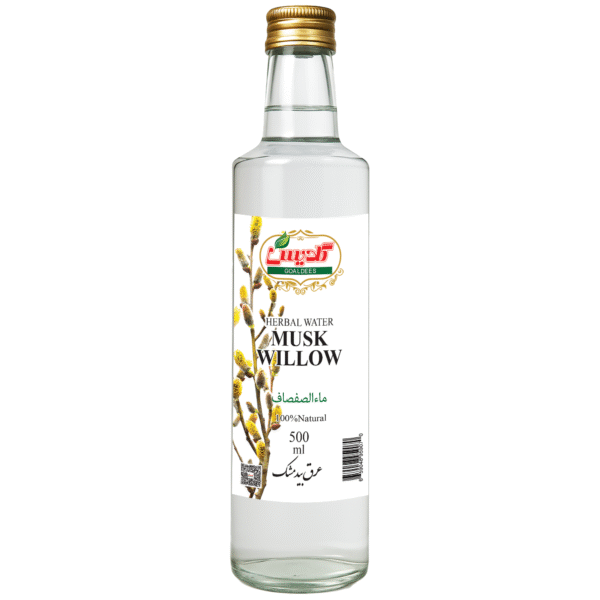
Musk Willow Herbal Water (Bidmeshk) 500 ml
Original price was: $5.80.$4.48Current price is: $4.48. -

-