
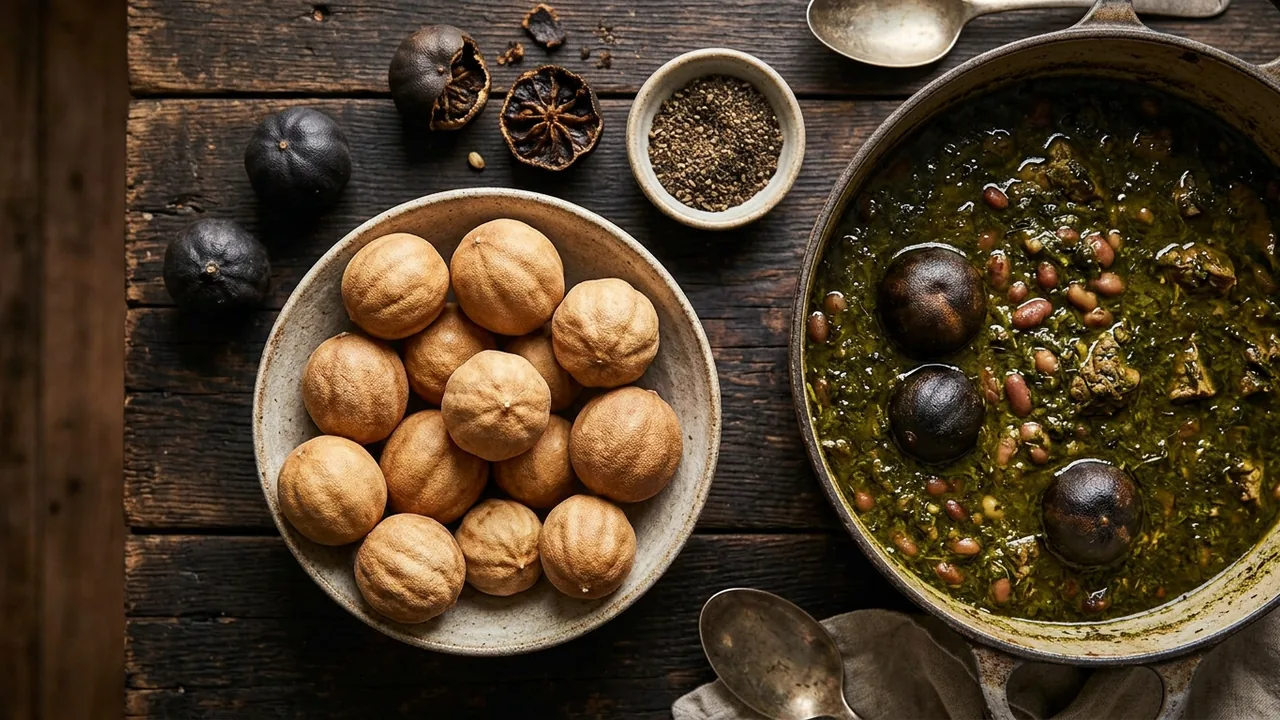
Black Lime (Limoo Amani): What Dried Limes Are and How to Cook With Them
A black lime is a whole lime dried until it is hard, hollow and almost weightless — the ingredient Iranians call limoo amani (لیمو عمانی), and the reason a pot of ghormeh sabzi tastes deep and sour rather than simply tangy. Black lime, dried lime, loomi and limoo amani are one ingredient under several names, and it behaves nothing like fresh citrus. This guide covers how dried limes are made, why some are tan and some are black, how Persian cooks use them without turning a stew bitter, which substitutes are honest, and what the research does and does not say about them.
What Is a Black Lime?
Start with a fresh lime and take the water out of it. What remains is a light, brittle shell with dried pulp and loose seeds inside. Saveur describes the finished fruit as walnut-sized and dried until the seeds and pulp move freely inside a dry, leathery skin. Shake a good one and you can hear it.
How the water comes out depends on who is drying them. Saveur and Food & Wine both describe fresh limes boiled or blanched briefly in salted water and then left in the sun; Food & Wine puts the sun-drying at several weeks, until the skins turn deep brown or black and the insides dry out completely. The Iraqi food historian Nawal Nasrallah describes something different for the limes sold in Iraq: she writes that they dry naturally on the tree. Different producers, different methods, but the finished ingredient is recognisably the same.
One thing a black lime is not: the thin, dehydrated lime wheels sold for cocktails. Food & Wine flags these as a different ingredient altogether, mostly meant for drinks.
One Ingredient, Several Names
- Limoo amani — the Persian name, also written limu omani or limoo omani. Encyclopaedia Iranica glosses it as “lime of Oman” and suggests the name stuck because the limes used to be imported from there. Najmieh Batmanglij, in her cookbook Joon, gives the same meaning.
- Noomi Basra — the Iraqi name. Nasrallah explains it by trade route: the limes reached Iraq from India and Oman through the southern port city of Basra.
- Loomi, black lime, dried lime — the names you will also see in English-language cookbooks and spice shops.
Lemon or lime? Why our shelf and our bag disagree
In Persian, limoo (لیمو) is far less specific than the English words. Encyclopaedia Iranica notes that in modern Iran the word covers all kinds of limes, lemons and limettas, and that people sort them simply into limoo shirin (لیمو شیرین), sweet, and limoo torsh (لیمو ترش), sour.
That is why our dried limoo amani appears in the shop as “Dried Lemon (Limoo Amani)” while the bag itself reads “Dried Lime.” Both are faithful translations of the same Persian word. Nasrallah’s own glossary also calls the ingredient Omani lemon. Botanically, the Iranian sources cited by Iranica identify limoo amani with Citrus aurantifolia, the small sour lime.
Not the supermarket “Persian lime”
The fresh fruit sold as “Persian lime” in American supermarkets is a separate question. Iranica records that a citrus specialist who examined specimens sent to him from Iran could not match any of them to the fruit sold under that name in the United States. Despite the shared word, do not assume a fresh “Persian lime” is the same fruit that ends up as limoo amani.
Tan or Black: What the Colour Tells You
Dried limes range from pale tan to almost coal-black. Saveur attributes the range to drying time: the longer they dry, the darker they get, running from parchment brown to charcoal. “Black lime” is the name for the dark end of that range, not a separate product.
Colour still guides how cooks use them. The same Saveur piece notes that paler limes tend to go into lighter-coloured dishes and the black ones into darker stews, even though the limes are often lifted out before serving.
Ours are the light tan-brown kind, sold whole. The product description calls them intense and smoky-sour, made for stews, soups and rice, which is exactly where a whole dried lime earns its place.
What Does a Black Lime Taste Like?
Sour first, then something deeper. Saveur describes the flavour as sour and musky at the same time. Max Falkowitz at Serious Eats goes further: sweet, sour and richly fermented, with a hint of asafoetida and the kind of layered acidity you would expect from a very good vinegar. Bahraini chef Noor Murad, quoted in Food & Wine, settles on earthy, bitter and tangy.
What it does not taste like is fresh lime. Batmanglij is explicit that dried limes taste distinctly different from fresh ones. The brightness is gone; in its place is a darker, rounder sourness with a bitter edge. That bitter edge is welcome in small doses and unpleasant in large ones, and managing it is most of what the technique below is about.
How to Cook With Dried Limes
Whole and pierced: the Persian default
In a khoresh (خورش), the slow-simmered Persian stew, dried limes almost always go in whole. Pierce each one first; Batmanglij recommends several holes made with the point of a knife. Saveur explains the reason: the holes let the cooking liquid into the fruit, rehydrating it so it can release its flavour. Without the holes, the liquid has no easy way in.
Once in the pot, they work slowly and steadily. Falkowitz points out that the sourness they release stays bright even after hours of simmering, which is exactly what a long-cooked stew needs. Our recipes use two to four limes per pot and add them once the beans or split peas have had a head start; the abgoosht recipe linked below explains why that order matters.
At the end, lift them out. Some cooks press each softened lime against the side of the pot first to squeeze out its last juice, a step Serious Eats and Food & Wine both describe. What you should not do is break the limes open and leave the pieces in the stew.
Why crushed limes make a stew bitter
The bitterness lives mainly in the seeds. Batmanglij warns that dried lime powder tends to taste bitter precisely because it contains ground seeds. Nasrallah gives the same instruction for Iraqi recipes that call for ground dried lime: take the seeds out before grinding, or they leave a bitter aftertaste. Food & Wine adds that the skins themselves can be quite bitter, which is the other reason the limes come out before the dish is served.
That is the logic behind the advice in our stew recipes: pierce, keep whole, never crush into the pot, lift out before serving. A whole lime gives up its sourness through the holes. A crushed one dumps seeds and pulp straight into the sauce, and there is no getting them back out.
Crushed and ground dried lime
Ground dried lime has its own uses; it is just not a straight swap in a Persian stew. Batmanglij calls the powder gard-e limoo amani (گرد لیمو عمانی). Saveur notes that it is made by breaking the limes open, removing the seeds and grinding the shells, and recommends it on seafood and lentils or as a rub for meat. Food & Wine describes ground dried lime as a staple of Gulf spice blends and a good addition to dressings and marinades.
Two practical points from Falkowitz: whole dried limes are hard to grind finely at home, so ready-ground powder is worth buying; and the powder’s flavour fades quickly, so buy a little at a time.
| Form | How to use it | Best for |
|---|---|---|
| Whole, pierced | Pierce several times, add once the legumes have a head start, lift out before serving | Ghormeh sabzi, gheymeh, abgoosht, khoresh bademjan |
| Crushed, seeds removed | Crack open and discard the seeds first; use as the recipe directs | Iraqi dishes that call for crushed noomi Basra |
| Ground (seeded) | A pinch at a time, tasting as you go; buy small and use quickly | Rubs for meat and seafood, lentils, dressings, marinades, Gulf spice blends |
| Omani lime paste | About a tablespoon, stirred in for the last half hour of cooking | Stews, soups and rice when you have no whole limes |
The Persian Dishes That Depend on Them
Dried lime is the souring backbone of several of the best-known Persian stews:
- Ghormeh sabzi (قورمه سبزی) — the herb, kidney bean and meat stew often called Iran’s national dish. The sautéed herbs carry its flavour; the dried limes give it its distinct tang.
- Gheymeh (قیمه) — split peas, meat and tomato, soured with dried lime and finished with crisp fried potato straws. Swap the potatoes for fried eggplant and it becomes gheymeh bademjan.
- Abgoosht (آبگوشت) — lamb, chickpeas and white beans simmered for hours. The dried limes go in only after the beans have had their start.
- Khoresh bademjan (خورش بادمجان) — eggplant stew, where dried lime is one of three traditional souring choices alongside verjuice and sour grape paste.
- Khoresh karafs (خورش کرفس) — a celery, parsley and mint stew that can be soured with either fresh lime juice or dried limes, depending on the cook.
If you are deciding which one to cook first, our guide to Persian khoresht compares them side by side.
Beyond Iran: Iraq and the Gulf
Dried limes are just as much at home across the Gulf and in Iraq. Saveur calls them essential in the Persian Gulf countries and in northern India. Nasrallah writes that noomi Basra gives a pleasant tang to Iraqi dishes and is also brewed into tea; Food & Wine names that infusion chai noomi. Noor Murad describes Bahraini tikka, in which lamb or beef is marinated in a black lime rub and grilled over charcoal. And Falkowitz singles out fish, where the lime’s funk adds nuance rather than just acidity.
Dried Lime Substitutes: What Works, and Why None Is Identical
Nothing reproduces a dried lime exactly, because the drying itself creates the flavour. Fresh citrus is bright; dried lime is dark, musky and slightly bitter. Choose a substitute according to which half of that you need most.
- Omani lime paste. The closest option, because it is the same ingredient in a ready-to-use form. Our Omani lime paste is made to capture the smoky-sour flavour of dried Persian limes with no grinding required. In our abgoosht recipe we suggest about a tablespoon, added in the last half hour.
- Fresh lime juice plus zest. This gives you the sourness and citrus aroma but not the depth. Nasrallah suggests 1 tablespoon of lime juice and 1 teaspoon of grated rind for each dried lime, while noting that the real thing gives a dish a more distinctive aroma and taste. Bottled lime juice works the same way; add it gradually and taste.
- Ground dried lime. Usable in a pinch, a little at a time. Powder that includes ground seeds can taste bitter, and its aroma fades quickly once ground.
- Verjuice. Ab-ghooreh (آب غوره), the juice of unripe grapes, is the other classic Persian souring agent. It is a different flavour, clean and fruity rather than musky, which is why our khoresh bademjan recipe offers it as an alternative rather than an equivalent. Our guide to verjuice explains how to use it.
How to Make Black Limes at Home
Saveur gives a simple home method: blanch fresh limes in salted water, then dry them on a rack in the sun or in an airy pantry for at least a week. They are ready when they are hard and light, and the seeds and pulp move loosely inside — the same rattle you get from a shop-bought one.
Food & Wine describes a slower, deliberately unorthodox route used by chef Farideh Sadeghin, who learned it from her Iranian father: let the limes shrivel in the fridge, then finish drying them on the counter or somewhere cool. She puts the whole process at around six months, and admits it is not the traditional way.
How to Store Dried Limes
Keep them whole until you need them. Saveur notes that whole dried limes keep for a long time (it suggests up to two years), while grinding releases their volatile oils and shortens their life considerably. Food & Wine recommends a cool, dry place. If you buy powder, buy small amounts, since its flavour fades quickly.
Are Dried Limes Good for You?
The short answer: they are a flavouring, and the evidence for anything beyond that is thin.
Drying costs a lot of vitamin C. Limes contain vitamin C, but it breaks down with heat and long drying. In a 2020 study in Heliyon, Indonesian researchers dried sliced limes in a hybrid solar-and-gas dryer at temperatures from 40 to 80 °C. Compared with the starting fruit, vitamin C fell by roughly half even at the gentlest setting and by more than 90% at the hottest, and phenolic compounds dropped as well. That was sliced fruit in a machine dryer, not whole limes dried in the sun, so the exact numbers do not transfer. The direction is clear, though, and a dried lime then spends an hour or more in a simmering stew before it is lifted out.
The human evidence is one small trial. Dried lime is a traditional Iranian self-remedy for cold symptoms, especially among pilgrims, so researchers at Shiraz University of Medical Sciences tested it: 112 Iranian Hajj pilgrims took either a 500 mg capsule of powdered dried lime or a placebo, once a day for four weeks. Symptom scores were lower in the lime group around the second week, but by the end of the study there was no statistically significant difference between the groups.
Beyond that, published research on dried lime itself is sparse; a PubMed search for the term turns up only a handful of papers. So enjoy dried limes for what they reliably do, which is make food taste better. If you are dealing with a health condition, talk to your doctor rather than relying on dried lime as a remedy.
Frequently Asked Questions
What does a black lime taste like?
Sour, musky and faintly bitter, with a fermented depth that fresh lime does not have. Food writers describe it as earthy and tangy, and Persian cooks treat it as a different ingredient from fresh lime rather than a stronger version of it.
What is black lime used for?
Mainly for souring slow-cooked dishes. In Persian cooking, whole dried limes are pierced and simmered in stews such as ghormeh sabzi, gheymeh and abgoosht; ground dried lime goes into rubs, marinades and Gulf spice blends, and in Iraq the limes are also brewed as tea.
How do you make black lime at home?
Blanch fresh limes in salted water, then dry them on a rack in the sun or in an airy pantry for at least a week, until they are hard and light and the seeds rattle inside. Traditional producers sun-dry them for several weeks.
What can I use instead of black lime?
The closest swap is Omani lime paste, which is dried lime in a ready-to-use form. Otherwise, use about 1 tablespoon of fresh lime juice plus 1 teaspoon of grated zest per dried lime; it supplies the sourness but not the musky depth.
Do Persian limes have seeds?
Yes. Dried Persian limes (limoo amani) keep their seeds loose inside the dried shell, and those seeds are the main source of bitterness. That is why Persian cooks pierce the limes and simmer them whole rather than crushing them into the pot.
Are dried limes good for you?
Treat them as a flavouring rather than a health food. Drying destroys much of a lime’s vitamin C, and the only human trial we found, in which 112 pilgrims took dried lime capsules for four weeks, showed no significant effect on cold symptoms.
Sources
- Citrus Fruits — Houshang Alam, Encyclopaedia Iranica, Vol. V, Fasc. 6, 1991 (updated 2013). The range of meaning of Persian limoo, the gloss of limoo amani as lime of Oman, its identification with Citrus aurantifolia, and the note on the American Persian lime.
- Limes, Dried Persian — Najmieh Batmanglij, Joon: Persian Cooking Made Simple, Mage Publishers, 2015. The name, the advice to pierce whole limes, and why powder containing seeds turns bitter.
- Iraqi Ingredients: Noomi Basra — Nawal Nasrallah, companion site to Delights from the Garden of Eden. The Iraqi name and trade route, tree-drying, removing seeds before grinding, the lime-juice substitute ratio and dried lime tea.
- Sour Power: Cooking with Dried Limes — Gabriella Gershenson, Saveur, 2011 (archived copy). Brining and sun-drying, colour as a function of drying time, uses of the powder, storage and the home method.
- Dried Limes Look Bold — and Taste Even Bolder — Yasmin Khan, Food & Wine, 2026. Blanching and sun-drying, flavour and Gulf uses as described by Noor Murad, bitter skins, chai noomi and storage.
- Spice Hunting: Limu Omani (Dried Limes) — Max Falkowitz, Serious Eats, updated 2020. Flavour, slow release of acidity in long cooking, and handling the ground powder.
- Towards an optimal hybrid solar method for lime-drying behavior — Suherman S, Hadiyanto H, Susanto EE, et al., Heliyon, 2020;6(10):e05356. Vitamin C and phenolic losses as drying temperature rises.
- Preventive Efficacy of Dried Lime (Citrus aurantifulia) in Common Cold Among Hajj Pilgrims: A Randomized, Double-Blinded, Placebo-Controlled Clinical Trial — Pasalar M, Mosavat SH, Molavi Vardanjani H, et al., Galen Medical Journal, 2020;9:e1462. The only human trial of dried lime we found.
This article covers the culinary use, naming and traditional preparation of dried limes. It is general information, not medical advice, and nothing here is a claim that dried lime treats or prevents any condition.
Cooking khoresh for a restaurant or catering? Dried limes, Omani lime paste and our other kitchen staples are available at a wholesale price on orders of $1,000 or more, with free shipping in LA, Orange County and San Diego.
Shop Dried Limes and Persian Souring Agents
The products this guide mentions, from Goaldees (also searched as Goldis), shipped nationwide across the US.