
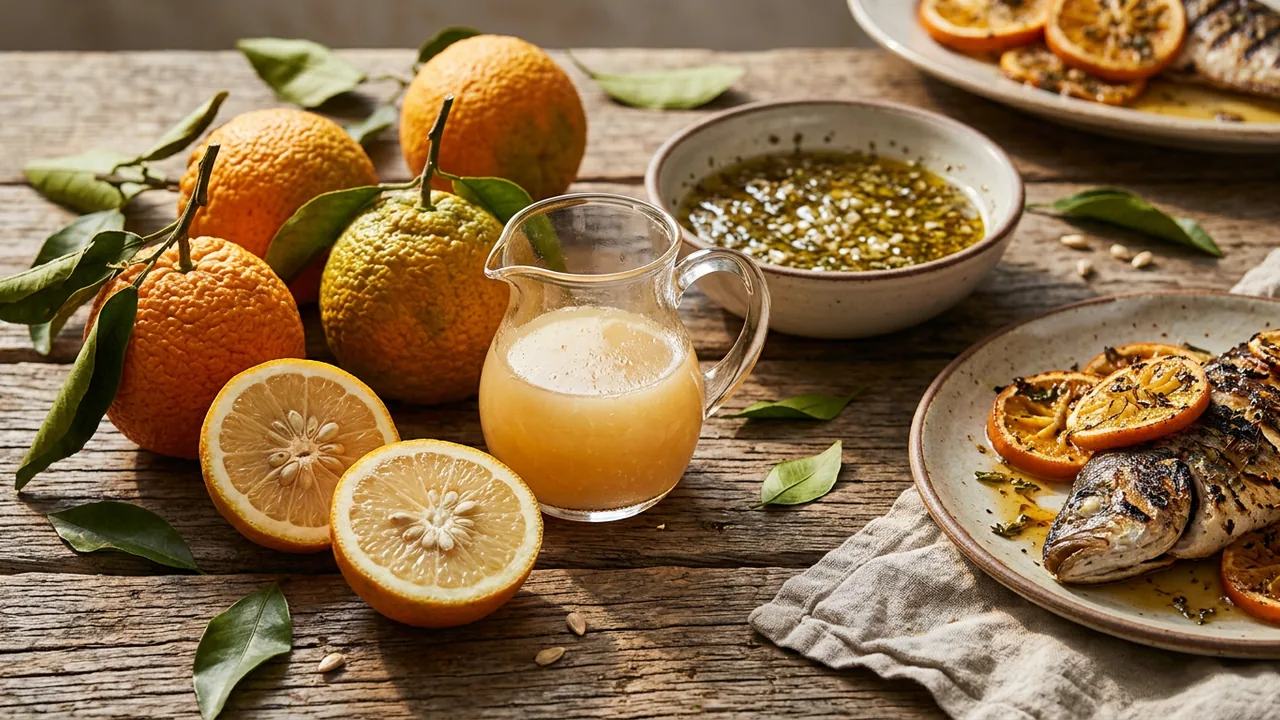
Sour Orange Juice (Narenj, Naranja Agria): What It Is and How to Cook With It
Sour orange juice is the juice of Citrus aurantium, the bitter or Seville orange — a fruit too sour to eat out of hand, used in the kitchen as a souring liquid the way you would use lime juice or a mild vinegar. Iranians call it ab-e narenj (آب نارنج); in Spanish-speaking Latin America and the Caribbean it is naranja agria. It is the same fruit in both kitchens, though few guides cover the two together. This guide covers what the fruit is, why its names are linked, how Persian and Latin American cooks use it, which substitutes are honest, and the one safety question that sends people searching: how the juice differs from “bitter orange” supplements.
What Is Sour Orange Juice?
The sour orange is a separate species from the oranges sold for eating. In Fruits of Warm Climates, the botanist Julia Morton describes the fruit as rough-skinned, with a fairly thick, aromatic, bitter peel that turns bright reddish-orange when ripe. Inside are 10 to 12 segments with bitter walls, strongly acid pulp and anywhere from a few to many seeds. The tree itself is more upright and compact than the sweet orange tree.
The US National Center for Complementary and Integrative Health (NCCIH) sums up the practical result: the fruit is too sour to eat raw, but the fruit, peel and essential oils are all used in cooking and as flavourings. Squeeze it and you get a sharp, aromatic, noticeably bitter juice that behaves more like lime juice than like a glass of orange juice.
Sour orange vs sweet orange
The sweet orange is Citrus sinensis. The two are closely tied: Morton notes that the sour orange is grown around the world more as a rootstock for sweet oranges than for its own fruit, and Encyclopaedia Iranica says the same of Iran. In the kitchen, though, they are not interchangeable. Sweet orange juice brings sugar and aroma; sour orange juice brings acid, aroma and a bitter edge.
Persian keeps them firmly apart. Narenj (نارنج) is the sour fruit. The sweet orange is porteghal (پرتقال), a name that, according to Iranica, literally means “Portugal” and points to the Portuguese role in bringing the sweet orange to Iran. The old word stayed with the sour fruit.
One Fruit, Many Names — and One Word
Here is a link few guides make. The Spanish word naranja and the Persian word narenj are the same word. The Real Academia Española traces naranja through Hispanic Arabic and Arabic nāranǧ to Persian nārang, and from there to Sanskrit nāraṅga. So a Cuban cook asking for naranja agria and a Persian cook asking for ab-e narenj are, linguistically as well as botanically, asking for the same thing.
| Name | Where you will see it | Notes |
|---|---|---|
| Narenj (نارنج) | Persian | The fruit. Its juice is ab-e narenj, “narenj juice,” on the same pattern as ab-e limoo for lime or lemon juice. |
| Naranja agria | Spanish: Cuba, Mexico, the Caribbean | Morton also records naranja ácida and naranja amarga. The RAE defines naranja agria by its harder, rougher peel and a taste “between sour and bitter.” |
| Seville orange | English, especially for marmalade | The tree was cultivated around Seville by the end of the 12th century, and marmalade is the fruit’s biggest food use. |
| Bitter orange | English; supplement labels | Also bigarade. This is also the name used for dietary supplements, which is where most of the safety confusion starts. |
| Bahar narenj (بهار نارنج) | Persian | The blossom of the same tree, distilled into orange blossom water. |
The orange blossom water in Persian sweets and sharbat comes from this very tree; our guide to aragh bahar narenj explains how the blossom water is made and why it is a different product from the peel extract sold as a supplement. For other pantry terms, see the Persian food glossary.
How One Orange Reached Two Cuisines
Morton’s history explains the overlap. The sour orange is native to southeastern Asia. Arabs are thought to have carried it to Arabia in the 9th century; it was growing in Sicily by 1002 and cultivated around Seville by the end of the 12th century. For 500 years it was the only orange in Europe, and it was the first orange to reach the New World.
From there it spread fast. Morton records it naturalized in Mexico by 1568 and in Brazil by 1587, and soon running wild in Jamaica, Puerto Rico and Barbados. Spaniards brought it to St. Augustine, Florida. Today it grows wild from Mexico to Argentina and is grown commercially in places that include the Middle East, North Africa, Haiti and the Dominican Republic.
In Iran the tree is everywhere. Iranica describes narenj as a favourite evergreen wherever the climate allows: planted along city streets in Mazandaran, the principal citrus crop of Gilan (it is the most cold-resistant citrus tree in the country), and so common in many towns of Gorgan, Mazandaran and Fars that hardly a house lacks one. Shiraz’s 19th-century orangeries, the Bagh-e Delgosha and the Narenjestan-e Qavam, are among the city’s best-known sights in blossom season.
What Does Sour Orange Juice Taste Like?
Sour, orange-scented and bitter. J. Kenji López-Alt, writing for Serious Eats, describes the Seville orange as having the aromatic nature of a navel orange but a great deal more bitterness and astringency in its juice. The Spanish dictionary definition says the same thing in four words: entre agrio y amargo, between sour and bitter.
That combination is the whole appeal. Lime juice is sour without the orange perfume; sweet orange juice has the perfume without the bite. Sour orange juice has both, plus a bitter edge of its own. Morton notes that in Yucatán it is used the way other cooks use vinegar.
How Persian Cooks Use Ab-e Narenj
The Goaldees sour orange juice comes in a 500 ml bottle; the label reads “SOUR ORANGE JUICE” and آب نارنج and describes it as “100% Natural.” The product copy calls it “a traditional Persian souring agent used to brighten stews, salads, and marinades,” and the published record fills in the detail.
- With fish at Nowruz. Nader Mehravari, writing on Persian cookery for Serious Eats, lists the classic first meal of the new year as sabzi polo (herbed rice), pan-fried fish and kuku sabzi, and notes that slices of Seville orange (or ground dried lime) are sometimes served on the side so diners can brighten the meal. Morton, writing about the fruit worldwide, likewise notes that the juice is valued as a flavouring on fish. Our sabzi polo recipe covers the rice, and the Nowruz foods guide covers the rest of the table.
- Cooked down into a sour paste. According to Iranica, the thickened juice, rob (رب), is widely used as a sour condiment.
- In older cookbooks, behind lime. Iranica notes that, compared with ab-e narenj, lemon or lime juice has many more uses in the Safavid-era cookbooks. So ab-e narenj appears in the old cookbooks, but as the less-used of the two.
- The rest of the fruit. The same entry describes preserves made from the blossoms, the peel or the whole seeded fruit; peel used in the rice dishes shirin polo (شیرین پلو) and morasa polo (مرصع پلو) and in a special Shiraz khoresh; and peel pickled on its own.
Many of the stews in our guide to Persian khoresht get their tang from dried lime or pomegranate paste. Sour orange juice is the option when you want sourness with an orange aroma instead.
How Latin American and Caribbean Cooks Use Naranja Agria
Cuban mojo
In Cuba the juice is the base of mojo. López-Alt describes the marinade for Cuban-style roast pork as a sauce made with the juice of sour oranges, cut with garlic, oregano, cumin and olive oil: no cooking, blending or emulsifying, “a loose vinaigrette,” in his words. Half is used to marinate the pork and half is kept back as a sauce for the table.
He is also honest about what a marinade does: mojo mostly flavours the outside of the meat, and any tenderizing from the citrus acid is not really noticeable.
Yucatán: cochinita pibil and its condiments
On Mexico’s Yucatán Peninsula, López-Alt counts bitter orange juice, with charred garlic, as essential to the cooking as the spices themselves. He writes that true cochinita pibil, pork rubbed in achiote and slow-cooked in banana leaves in a pib (the Maya underground oven), gets its sweet, earthy aroma from bitter Seville oranges, achiote and charred garlic. The juice goes into the achiote marinade, and he calls it the key ingredient in all three of the Yucatán-style condiments served alongside, from pickled red onions to fiery salsa.
Mexican cooks also eat the fruit more directly. Morton describes sour oranges cut in half, salted, coated with a paste of hot chili peppers and eaten as they are.
Puerto Rico, Spain and beyond
Puerto Rico has a green, herb-heavy mojo of its own. López-Alt’s mint mojo, based on the Puerto Rican style, blends mint, parsley, garlic and olive oil with lemon and a couple of tablespoons of sour orange juice; he describes the Puerto Rican version as close to an Italian salsa verde. In Spain, Morton notes, the juice is used on meat during cooking.
Sour Orange Juice Substitutes
Fresh sour oranges are hard to find in the US: López-Alt notes they can be hard to locate even in citrus season unless you have a particularly good Latin market nearby. In rough order of closeness:
- Bottled sour orange juice. The real thing, ready to pour. If a recipe was written with a substitute, reverse it: López-Alt’s mojo recipe says that if you can find sour Seville oranges, use their juice in place of both the orange juice and the lime juice.
- Orange, lime and grapefruit. For his cochinita pibil, López-Alt follows the recommendation of David Sterling, author of the cookbook Yucatán, to combine lime, navel orange and grapefruit juice; his recipe swaps 3/4 cup bitter orange juice for 1/4 cup of each. The idea is that each fruit stands in for one part of the original: sourness from the lime, orange aroma from the orange and a bitter edge from the grapefruit.
- Orange and lime, two to one. The simplest blend. His Cuban mojo uses 1/2 cup orange juice to 1/4 cup lime juice, which he calls a close-but-not-perfect approximation of the real deal. It lacks the bitterness that sets sour orange apart.
- A splash of white vinegar. For extra sharpness, López-Alt also blends a glug of white vinegar into his pibil marinade, on top of the juice, “for acidity.”
In a Persian kitchen there are two more options, neither of them a copy. Lime juice gives you the sourness without the orange perfume. Verjuice is sour and fruity in a green-apple way rather than a citrus way; our verjuice guide explains how it behaves. Either works in a salad dressing or a stew; neither tastes of narenj.
One caution about grapefruit. If you avoid grapefruit because of a medication, the grapefruit blend is out, and so, as the next section explains, is the real sour orange.
Is Sour Orange Juice Safe? Juice vs “Bitter Orange” Supplements
Search “bitter orange” and most of what comes back is about dietary supplements, not food. The two need separating.
The supplements are a different product
NCCIH explains that bitter orange is promoted as a dietary supplement for weight loss and sports performance. The fruit contains p-synephrine, a compound structurally similar to ephedrine though it acts differently in the body, and bitter orange products became more popular after the FDA banned ephedra in supplements in 2004. The NCAA lists synephrine (bitter orange) as a banned stimulant.
The safety concerns NCCIH describes are about those products. Serious events, including abnormal heart rhythms, heart attacks and strokes, have been reported in people taking bitter orange supplements, although most of those products contained several ingredients, so the role of bitter orange is unclear. Quality is a problem too: when FDA researchers analysed 59 bitter orange supplements, six were adulterated with synthetic amines that are not legal dietary ingredients. NCCIH’s overall verdict is that bitter orange “has not been clearly shown to be helpful for any health-related purpose.”
The juice, used as a seasoning
On food, NCCIH is direct: bitter orange is “likely safe when used orally in amounts commonly found in foods.” A few tablespoons of juice in a marinade or a dressing is a food amount; a supplement taken for weight loss is a different product altogether. The distinction is about form and dose, not a claim that the fruit is harmless in any quantity. We make no health claims for the juice: it is a seasoning.
The real caution: medications
One warning does apply to the fruit itself. Grapefruit juice can block an enzyme in the small intestine, CYP3A4, that breaks down many drugs, so more of the drug reaches the blood. The US Food and Drug Administration names sour oranges in the same breath. In its words: “Seville oranges (often used to make orange marmalade), pomelos, and tangelos (a cross between tangerines and grapefruit) might have the same effect as grapefruit juice. Do not eat those fruits if your medicine interacts with grapefruit juice.”
So if your prescription label or pharmacist tells you to avoid grapefruit, treat sour orange juice the same way and ask first. NCCIH also advises anyone taking medicine to talk with a health care provider before using bitter orange or other herbal products, and says bitter orange may not be safe during pregnancy or breastfeeding; if either applies, ask your doctor whether a seasoning amount is fine.
How to Store Sour Orange Juice
We found no reliable published guidance on how long bottled sour orange juice keeps once opened, so follow the storage instructions on the bottle’s label.
Frequently Asked Questions
What is sour orange juice?
Sour orange juice is the juice of Citrus aurantium, the bitter or Seville orange, a citrus species too sour to eat raw. Persian cooks call it ab-e narenj and Latin American cooks call it naranja agria; both use it as a souring liquid in marinades, dressings and sauces.
Is sour orange the same as bitter orange or Seville orange?
Yes. Sour orange, bitter orange, Seville orange and bigarade are all names for Citrus aurantium. In Spanish it is naranja agria, naranja ácida or naranja amarga, and in Persian it is narenj.
What is naranja agria in English?
Naranja agria means sour orange, the same fruit as the bitter or Seville orange. The Spanish word naranja comes, through Arabic, from the Persian nārang, which is why the Persian name narenj sounds so similar.
What can I substitute for sour orange juice?
Bottled sour orange juice is the closest option. Otherwise, mix equal parts lime, orange and grapefruit juice, or use two parts orange juice to one part lime juice, which is simpler but has none of the bitterness; a splash of white vinegar adds extra acidity.
What is sour orange juice used for?
Mainly as a souring agent. It is the base of Cuban mojo and of the achiote marinade for Yucatecan cochinita pibil, and in Persian cooking it is used in stews, salads and marinades, with fish, and cooked down into a sour paste.
Is sour orange juice safe to drink?
In food amounts, NCCIH considers bitter orange likely safe; the safety warnings you see online are about bitter orange dietary supplements sold for weight loss. The real caution is medication: the FDA says Seville oranges might interact with drugs the way grapefruit juice does, so avoid them if your medicine interacts with grapefruit.
Sources
- Sour Orange — Julia F. Morton, Fruits of Warm Climates, 1987, pp. 130–133 (Purdue University NewCROP). Description of the fruit, its names, its spread from Asia to Spain and the Americas, and its food uses.
- Citrus Fruits — Houshang Alam, Encyclopaedia Iranica, Vol. V, Fasc. 6, 1991 (updated 2013). Narenj in Iran, the Persian name of the sweet orange, sour orange rootstock, and Persian uses of the juice, paste, peel and blossoms.
- Naranja — Real Academia Española, Diccionario de la lengua española, 23rd edition (online). The Persian origin of the word naranja and the definition of naranja agria.
- Celebrate Spring the Persian Way With Herb-Packed Eggs, Crispy-Bottomed Rice, and Sweets to Share — Nader Mehravari, Serious Eats, 2026. The Nowruz meal of herbed rice and fish, with Seville orange slices served on the side.
- Cochinita Pibil (Yucatán-Style Barbecued Pork) — J. Kenji López-Alt, Serious Eats, updated 2025. Flavour of Seville orange juice, its role in Yucatán cooking, and the lime, orange and grapefruit substitute.
- Cuban-Style Roast Pork Shoulder With Mojo — J. Kenji López-Alt, Serious Eats, updated 2025. What goes into mojo, the orange and lime substitute, and using real sour orange juice in its place.
- Mint Mojo (Puerto Rican-Style Garlic Sauce With Mint) — J. Kenji López-Alt, Serious Eats, updated 2025. The Puerto Rican green mojo made with sour orange juice.
- Bitter Orange — National Center for Complementary and Integrative Health (NIH), updated November 2024. Supplement uses and safety concerns, and the safety of bitter orange in food amounts.
- Grapefruit Juice and Some Drugs Don’t Mix — US Food and Drug Administration, Consumer Update, 2021. How grapefruit affects drugs and the warning that Seville oranges might have the same effect.
This article covers the botany, naming and culinary use of sour orange juice. It is general information, not medical advice, and nothing here is a claim that sour orange treats or prevents any condition. If you take prescription medication, especially one that carries a grapefruit warning, or are pregnant or breastfeeding, check with your doctor or pharmacist before using sour orange juice.
Making mojo or cochinita pibil for a restaurant? Sour orange juice and our other kitchen staples are available at a wholesale price on orders of $1,000 or more, with free shipping in LA, Orange County and San Diego.
Shop Sour Orange Juice and Persian Souring Agents
The products this guide mentions, from Goaldees (also searched as Goldis), shipped nationwide across the US.