
Persian Gaz: 18% vs 28% Pistachio, and How to Choose
Persian gaz is a soft, chewy nougat from Isfahan, made by whipping egg white into a cooked sugar paste and folding in pistachios or almonds. The percentage on the box, 18% or 28%, is the share of pistachio kernel in the candy. In a 350 g box that is 63 g of pistachio at 18% and 98 g at 28%, so the 28% box has about 55% more nut in it. More nut means a stronger pistachio flavour and a different bite, and that is the whole choice. Below: what gaz is and where its strange traditional sweetener comes from, what the grades buy you in grams and dollars, how to read a box, and how to keep it soft.
What Is Persian Gaz?
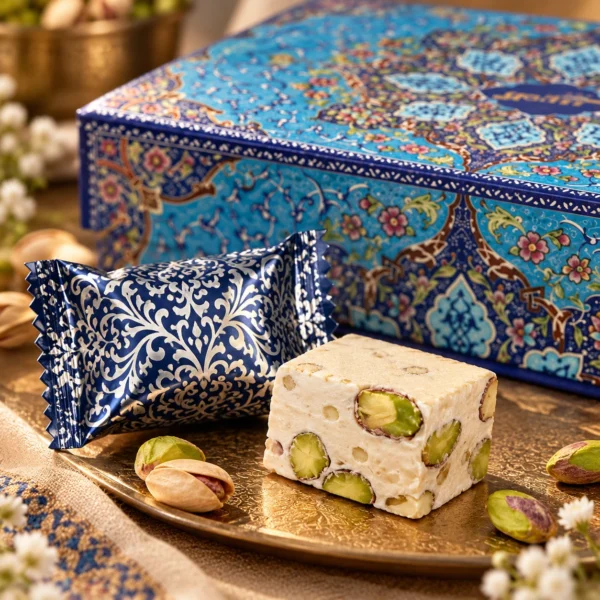
Gaz (گز) is one of Iran’s best-known confections and the sweet most associated with Isfahan. The Encyclopaedia Iranica describes the classic method: a sweet manna called gaz-angobin is dissolved in an equal amount of water, boiled gently and strained, and egg whites are added and beaten in. Sugar goes in next, and the mixture is cooked until it reaches the consistency of a paste. Shelled pistachios or almonds are then folded through, and the candy is shaped either into flat rounds three to four inches across or into small bite-size pieces. Each confectioner guards the exact recipe as a trade secret.
The result is unusual among nougats. It is soft and pulls apart when you bite it, but it is not sticky in the hand once set. Nineteenth-century travellers noted the same paradox: it is both adhesive and brittle. In Iranian homes gaz is a standard offering with tea for guests, and it appears on the table at Nowruz and on Yalda Night. For the wider family of Persian sweets, from noghl to rock candy, see our Persian sweets guide.
Gaz vs nougat: is gaz just Persian nougat?
Broadly, yes. Like European nougat or Italian torrone, gaz is a sugar syrup aerated with egg white and loaded with nuts. The differences are the flavouring and, traditionally, the sweetener. Gaz is perfumed with rose water rather than vanilla or honey, and its classic recipe uses gaz-angobin, a sweetener nougat elsewhere does not have.
Gaz-Angobin: The Sweetener That Is Not a Sap
Many websites, and until recently some of our own product pages, describe gaz-angobin as the “sap” of a plant. It is not, and the real story is stranger.
Gaz-angobin is collected from Astragalus adscendens, a very prickly grey-green shrub about a metre tall that grows wild in the mountains southwest of Isfahan. The manna is also called gaz-e Khansar, after a town in the harvesting area. The white, thread-like strings on its branches are not produced by the plant. They are excreted by the nymphs of a tiny jumping plant-louse, a psyllid. A 1988 study in Khansar described its life cycle, and a 1993 review of the psyllids of Iran identified the species as Cyamophila astragalicola. The insect completes one generation a year, and the strings are mostly secreted in its last nymphal stage.
The argument over this is two centuries old. In 1813 a European traveller in Persia, Captain Edward Frederick, watched “innumerable little insects” on the bushes near Khansar. He concluded that gaz was an animal product. In 1819 a Persian physician living in London rejected that. He wrote that gaz was the name of trees in the genus Tamarix, the tamarisk, and that all such mannas were exudations of the trees themselves. That is the origin of the tamarisk confusion you still see repeated. The Persian word gaz does cover several species of Tamarix as well as these Astragalus shrubs. But the manna used for the candy comes from the Astragalus, and Frederick was right about the insect. It took about 150 years for his observation to be accepted.
Harvesting has barely changed since Frederick described it in 1819. Between late August and mid-October, gatherers hold an oval leather bowl under the branches and tap the bush with a curved, leather-covered stick. They then sieve out the insects and leaf debris.
What this means when you buy. Real gaz-angobin is a wild, seasonal, hand-gathered product, so it is scarce and expensive. Modern gaz is commonly made with sugar and glucose syrup as well as, or instead of, the manna. The seven commercial samples in a 2015 study of gaz were described as made from nuts, gaz-angobin, sugar, glucose syrup, rose water and egg white. Neither approach is a defect. The word gaz on a box tells you the confection, not the sweetener, so read the ingredient panel if it matters to you.
18% vs 28% Pistachio Gaz: What the Number Buys You
The percentage is the pistachio kernel content. Persian boxes say exactly that: گز ۲۸ درصد مغز پسته, “gaz, 28 percent pistachio kernel.” We could not find a published standard that defines how the figure is measured, so treat it as the maker’s own declaration and compare within one brand. Within a brand, it is the most useful number on the box.
Here is what it works out to on the boxes we sell, at regular (non-sale) prices:
| Box | Weight | Pistachio in the box | Regular price | Grams of pistachio per $1 |
|---|---|---|---|---|
| 18% pistachio gaz | 350 g | ~63 g | $13.49 | ~4.7 g |
| 28% pistachio gaz | 350 g | ~98 g | $14.99 | ~6.5 g |
| 28% pistachio saffron gaz | 350 g | ~98 g | $14.99 | ~6.5 g |
| 28% pistachio gaz gift box | 300 g | ~84 g | $39.99 | ~2.1 g |
Three things fall out of that table:
- The 28% box is the better buy on nut content. It costs $1.50 more than the 18% box and contains about 35 g more pistachio, roughly 4¢ per extra gram. Per dollar, it delivers about 40% more pistachio. When both are on sale at the same price, the gap is bigger still.
- Saffron adds flavour and colour, not pistachio. The saffron gaz has the same 28% pistachio as the plain 28%. Choose between them on taste.
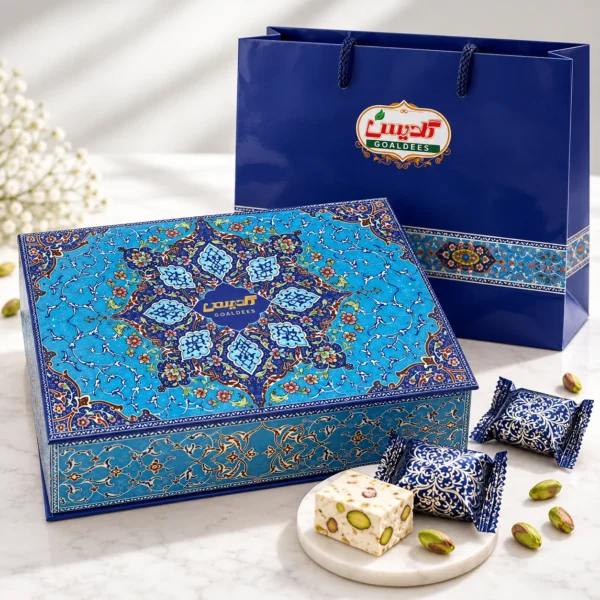
- The gift box costs about three times as much per gram of pistachio. It is the same 28% gaz, in roughly 23 individually foil-wrapped pieces, a rigid tile-patterned box and a matching gift bag. You are paying for presentation and portability. That is worth it when you are giving it away, and not when it is for your own cupboard.
Does more pistachio change the taste and texture?
Yes, but in a narrower way than you might expect. A 2015 study in the Journal of Texture Studies analysed seven gaz samples with an instrumental texture analyser, a trained tasting panel and aroma analysis. It found that the type and amount of nuts determined the intensity of the key flavour attributes, but of all the texture attributes measured, they changed only hardness. Chewiness, stickiness and the rest of the texture profile come from the nougat itself.
So the honest summary is this. A 28% gaz tastes more strongly of pistachio and has a different firmness in the bite. The softness and chew that make gaz gaz are there at both grades. If you mainly want the nougat, rose water and chew, 18% is not a lesser product, just a lighter one. If the pistachio is the point, buy 28%.
Which Gaz Should You Buy?
| If you want… | Buy | Why |
|---|---|---|
| The most pistachio for the money | 28% pistachio gaz, 350 g | ~6.5 g of pistachio per dollar, the best of the range |
| A lighter, sweeter everyday piece with tea | 18% pistachio gaz, 350 g | The same nougat with less nut; the cheapest box |
| A warmer, more aromatic gaz | 28% pistachio saffron gaz | Same pistachio content as the plain 28%, with saffron for aroma and colour |
| A gift for a host, or to post to family | 28% gaz gift box, 300 g | Individually wrapped pieces in a rigid box that needs no wrapping |
| Nowruz or Yalda guests | A 350 g box plus the gift box | Open the box for the table; bring the gift box when visiting |
How to Read a Gaz Box (Any Brand)
- Find the percentage, then the nut. The figure is usually printed large on the front. Check whether it says pistachio (pesteh, پسته) or almond (badam, بادام). Almond gaz is a legitimate, usually cheaper style, but a 28% almond gaz is not the same thing as a 28% pistachio gaz.
- Compare per 100 g, not per box. Box sizes vary widely, from 250 g to 450 g and more, and a cheaper box is often just a smaller one.
- Read the sweeteners on the back. Gaz-angobin (also written angabin or angebin, گزانگبین) means the traditional manna is in it; sugar and glucose syrup are the modern base. Many good gaz use both.
- Flour-dusted or wrapped. Traditional gaz-e ardi is packed loose in white flour, the way Iranian confectioners have long kept the pieces from absorbing moisture and sticking together. Individually wrapped pieces do the same job without the flour.
About ours. The Goaldees range is sold under our Persian-script mark, گلدیس, which is why you will also see it as “Goldis”. The boxes state the grade on the front (گز ۱۸ درصد مغز پسته and گز ۲۸ درصد مغز پسته) and are labelled “Traditional Isfahan Gaz” and “Traditional Persian Nougat.” We make no claim here about which sweetener is in them; as with any brand, the ingredient panel on the box is the authority.
How to Store and Serve Gaz
Gaz’s enemy is moisture. That is the whole reason for the traditional flour packing, and it is why an open tray left on the counter turns tacky. Keep gaz sealed in its wrappers or an airtight container, somewhere cool and dry and away from the stove and sunny windows.
Serve it the Iranian way, a piece or two on a small plate beside a glass of Persian tea. Bite-size pieces are the norm now. If you have a large round of flour-packed gaz, tap off the flour and cut it into wedges with a sharp knife.
Frequently Asked Questions
What does 28% mean on gaz?
It is the share of pistachio kernel in the candy. Persian boxes say it in full: gaz 28 percent pistachio kernel. In a 350 g box of 28% gaz that is about 98 g of pistachio, against about 63 g in the same size box at 18%.
Is 28% gaz better than 18%?
It has more pistachio, a stronger pistachio flavour and a different firmness in the bite, and at regular prices it gives about 40% more pistachio per dollar. The nougat, rose water and chew are the same at both grades, so 18% is a lighter version rather than a lower-quality one.
What is gaz made of?
Egg white whipped into a cooked sugar paste, perfumed with rose water and folded with pistachios or almonds. Traditionally the sweetener includes gaz-angobin, a manna gathered from Astragalus shrubs near Khansar. Modern gaz commonly uses sugar and glucose syrup as well, or instead.
Is gaz-angobin a plant sap?
No. It is excreted onto Astragalus adscendens shrubs by the nymphs of a small psyllid insect, Cyamophila astragalicola. The shrub is only the host. It is gathered by hand between late August and mid-October, which is why genuine gaz-angobin is scarce.
Does gaz come from tamarisk?
No, although the confusion is old. The Persian word gaz names several tamarisk species as well as the Astragalus shrubs, and in 1819 a Persian physician argued that the manna came from tamarisk trees. The manna used to make the candy comes from Astragalus adscendens.
Why is some gaz covered in flour?
Traditional gaz-e ardi is packed loose in white flour to stop the pieces absorbing moisture and sticking together. Individually wrapped gaz does the same job without the flour.
How long does gaz keep, and how should I store it?
Moisture is the main problem: keep it in its wrappers or an airtight container, somewhere cool and dry, and go by the best-before date on the box. Sealed and dry, it travels well, which is why it is such a common gift.
Sources
- GAZ (1) i. GAZ-ANGOBĪN — Bahram Grami, Encyclopaedia Iranica, Vol. X, Fasc. 4, pp. 348–352 (2000). Astragalus adscendens as the host shrub, the insect origin of the manna (Na’īm and Behdād 1988; Burckhardt and Lauterer 1993, Cyamophila astragalicola), Frederick’s 1813–1819 account and the tamarisk counter-claim, and the harvest season and method.
- GAZ (1) ii. CANDY — Mohammad Reza Ghanoonparvar, Encyclopaedia Iranica, Vol. X, Fasc. 4 (2000). How gaz is made, its shapes, flour packing, and the adhesive-and-brittle texture.
- GAZ (1) — Encyclopaedia Iranica. The word gaz as the Persian name for species of both Tamarix and Astragalus.
- Volatile Composition, Texture and Sensory Description of Gaz (Traditional Persian Confection) — Hojjati M, Speziale M, Noguera-Artiaga L, Carbonell-Barrachina ÁA, Journal of Texture Studies, 2015;46(6):440–454. Seven commercial gaz samples: ingredients, aroma compounds, and the finding that nut type and amount drive flavour intensity but affect only hardness among texture attributes.
Pistachio weights are calculated from the declared percentage and net weight on each box. Prices are Goaldees regular prices in October 2026 and may change; sale prices make the 28% comparison more favourable, not less.
Stocking a café, gift shop or corporate gift order? Gaz and our other Persian sweets are available at a wholesale price on orders of $1,000 or more, with free shipping in LA, Orange County and San Diego.
Shop Persian Gaz
The gaz this guide compares, from Goaldees (also searched as Goldis), shipped nationwide across the US.
-
Sale!

28% Persian Pistachio Gaz 350g
Original price was: $14.99.$13.49Current price is: $13.49. -

-
Sale!

28% Persian Pistachio Saffron Gaz 350g
Original price was: $14.99.$13.49Current price is: $13.49. -