
Persian Sweets Guide: Gaz, Noghl, Nabaat & More
Persian sweets are less about frosted cakes and more about nougat, candied nuts, and crystallized sugar — many rooted in centuries-old recipes tied to specific cities and regions. Here’s a guide to the classics, from the famous pistachio nougat of Isfahan to the rock candy that sweetens every cup of Persian tea.
Classic Persian Sweets
Gaz
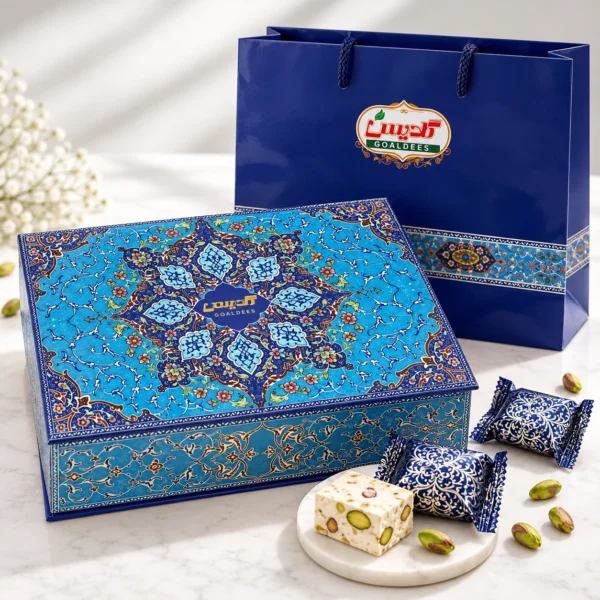
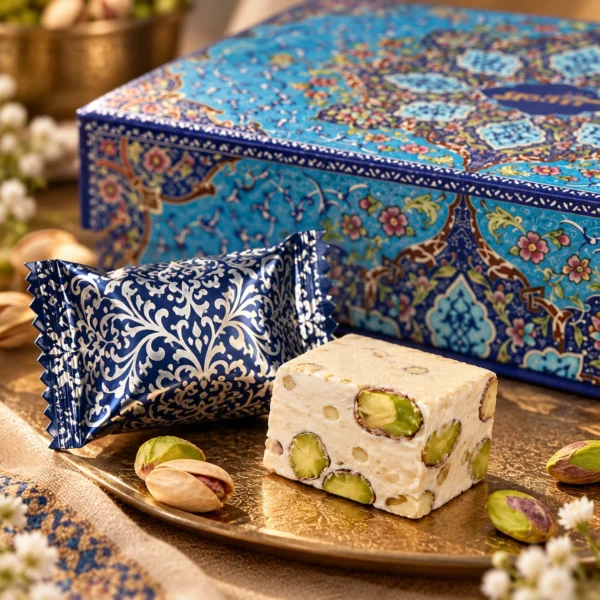
گز — Isfahan’s famous nougat, whipped with egg white, perfumed with rose water and studded with pistachios. Shop our 28% pistachio saffron gaz or the full sweets range.
What gaz-angebin actually is — and the myth worth correcting. The name comes from gaz-angebin, and gaz is very widely described as the “sap” of a tamarisk or manna plant. That is not quite right. The traditional sweetening manna is a honeydew secreted by psyllid insects (Cyamophila astragalicola and C. dicora) that live on Astragalus adscendens shrubs in the Zagros highlands around Khansar. The plant hosts the insects; the insects produce the manna. Historical sources confused this with plant exudate from Tamarix gallica and Astragalus brachycalyx, which is where the “sap” description came from.
Why that matters when buying: genuine Khansar manna is scarce and expensive, and much modern commercial gaz is made with sugar and glucose syrup instead. That is not necessarily a defect — plenty of excellent gaz is made this way — but it means “gaz” on a label tells you the confection, not the sweetener. The quality marker most Iranian buyers actually use is pistachio percentage: an 18% gaz and a 28% gaz are meaningfully different products, and the number is usually printed on the box. Our Persian gaz buying guide works out what each grade contains in grams of pistachio.
Noghl
نقل — Whole almonds or walnuts coated in a hard, often rose-flavored sugar shell — a traditional celebration candy served at weddings and holidays. Shop rose & walnut noghl or musk willow & walnut noghl.
Nabaat (Saffron Rock Candy)
نبات — Large crystals of rock candy, often infused with saffron, traditionally used to sweeten Persian tea one crystal at a time. Shop saffron nabaat, white nabaat, or saffron rock candy on a stick.
Nuqul (Frosted Almond Pearls)
نقل بادام — Small sugar-coated almond candies, similar to noghl but in a smaller, pearl-like form — a popular treat for gatherings. Shop frosted almond pearls.
Kak & Noon Berenji
کاک و نان برنجی — Traditional Kermanshah-style cookies — kak is a crumbly, spiced cookie, while noon berenji is a delicate rice-flour cookie. Shop Kermanshah kak or noon berenji.
Persian Cookies
شیرینی — Beyond the regional specialties, simple flavored cookies are a Persian tea-time staple. Shop coconut cookies or coconut cookies.
Cube Sugar
قند — Hard sugar cubes, the traditional way to sweeten Persian tea — held between the teeth while sipping, rather than stirred in. Shop cube sugar.
Why Nabaat Crystals Are Grown, Not Made
Nabaat is not simply sugar pressed into a shape. It is grown: a supersaturated sugar syrup is prepared, then held while dissolved sucrose comes out of solution and deposits onto a seed surface — a string, a stick, or existing crystals — over days. Slow, undisturbed cooling produces the large, clear crystals characteristic of good nabaat; rushing it yields many small cloudy ones instead.
That structure is the point. A large crystal has far less surface area relative to its mass than granulated sugar, so it dissolves slowly. Holding a piece of nabaat in the mouth while drinking tea sweetens each sip gradually rather than all at once — which is exactly how it is traditionally used, and why substituting a spoon of sugar is not the same experience.
How Persian Sweets Are Served
Most Persian sweets are built around tea culture — nabaat and cube sugar sweeten the tea itself, while gaz, noghl, and cookies are offered alongside it to guests. Sweets like samanoo carry deeper symbolic meaning, tied to specific celebrations like Nowruz.
Frequently Asked Questions
What is gaz made of?
Gaz is a nougat whipped from egg white and a sweetener, perfumed with rose water and studded with pistachios — a speciality of Isfahan. Traditionally the sweetener was gaz-angebin, a manna that is commonly called plant sap but is in fact a honeydew produced by psyllid insects living on Astragalus adscendens shrubs. Because that manna is scarce, most modern commercial gaz uses sugar and glucose syrup instead, and quality is usually judged by pistachio percentage.
What is the difference between 18% and 28% pistachio gaz?
The percentage is the proportion of pistachio in the finished nougat, and it is the main quality and price marker in the category. A 28% gaz is noticeably denser with nut and less dominated by the sugar base than an 18%; saffron-scented versions are a further variation on top of that. The gaz buying guide has the numbers.
Why is nabaat sold as large crystals?
Because the crystal size determines how it behaves. Nabaat is grown slowly from a supersaturated syrup onto a seed surface, producing large crystals with little surface area relative to mass — so they dissolve gradually. Held in the mouth while sipping tea, a piece sweetens each sip progressively, which granulated sugar cannot do.
How is nabaat different from regular sugar?
Nabaat is rock candy grown into large crystals, often infused with saffron, and is traditionally used to sweeten Persian tea by holding a piece in the mouth while sipping, rather than stirring in granulated sugar.
What is noghl used for?
Noghl — sugar-coated almonds or walnuts — is a traditional celebration candy, commonly served at Persian weddings and holiday gatherings.
What’s a good introduction to Persian sweets?
Gaz (pistachio nougat) and nabaat (saffron rock candy) are the two most iconic and widely enjoyed Persian sweets, and a great starting point for anyone new to them.
Sources
- GAZ — Encyclopaedia Iranica. Origin and terminology of gaz and gaz-angebin.
- Entomological and botanical descriptions of Persian manna as psyllid honeydew (Cyamophila astragalicola, C. dicora) on Astragalus adscendens, and the historical confusion with Tamarix gallica and Astragalus brachycalyx.
This article covers the history and culinary use of Persian sweets. It is general information, not medical or dietary advice; these are confections and are high in sugar. Several contain nuts, egg or dairy — check individual product labels for allergens.
Shop the Full Sweets Collection
Browse the complete range of authentic Persian sweets at Goaldees (also searched as Goldis), shipped fresh, nationwide across the US. Shop the full Sweets collection. For gifting rather than everyday eating, the 28% pistachio gaz gift box comes as individually wrapped pieces in a decorative box with a matching gift bag.
Shop Persian sweets
The sweets covered in this guide — add them straight to your cart.