
Persian Pistachio Varieties: Akbari, Fandoghi, Khalal & More
Iranian pistachios are sorted into two families — “round” varieties like Fandoghi and Kalleh Ghouchi, and “long” varieties like Akbari and Ahmad Aghaei — distinguished by the ratio of the nut’s length to its diameter. That single measurement drives shape, kernel size, price, and what each type is best used for. Here’s what the categories actually mean, backed by the industry’s own standards and published nutrition data.
How Iranian Pistachios Are Classified
The Iran Pistachio Association, the country’s official industry body, divides cultivars into two groups by a simple geometric measure: round varieties have a length-to-diameter ratio below 1.5; long varieties are above 1.5. It sounds technical, but it’s the distinction Iranian buyers actually use, and it maps directly onto how the nuts are sold and eaten.
Fandoghi (Round)
The workhorse of the Iranian crop. The Iran Pistachio Association reports Fandoghi accounts for around 50% of Iranian production. Its name comes from fandogh — hazelnut — a nod to its small, round shape. Small nuts mean the highest count per kilogram, which is why Fandoghi is the everyday snacking and confectionery pistachio rather than the showpiece.
Kalleh Ghouchi / “Jumbo” (Round)
Large, round, thick-shelled, with a notably plump kernel. It was a commercial success, but per the Iran Pistachio Association its yield is “highly affected by water shortage, water salinity and climatic fluctuations,” and it is no longer being budded — meaning current supply comes from existing trees rather than new planting. Worth knowing if you wonder why jumbo Iranian pistachios have grown scarcer and pricier.
Akbari (Long)
The premium long variety: large, elongated, with a dark cream shell and a kernel that often carries a brownish-purple cast. The Iran Pistachio Association notes it has the largest kernel-to-in-shell weight ratio of the Iranian cultivars — you’re buying more nut and less shell, which is exactly why it commands a premium.
Ahmad Aghaei (Long)
A newer commercial long variety the association describes as resembling the American Kerman cultivar, with acreage growing on the strength of its appearance and flavor in export markets. Smaller than Akbari, but prized for aroma — a common choice for confectionery and cooking.
Where Iran Sits in Global Production
Pistachio production is remarkably concentrated: the United States, Iran, and Turkey together account for roughly 97% of world output. FAO figures reported for 2022 put the United States at about 400,000 tonnes and Iran at roughly 242,000 tonnes, placing Iran second that year — though the ranking has alternated between the two countries over time, with Iran holding the top position as recently as 2019. Iranian output is sensitive to drought and water salinity, the same pressures that pushed Kalleh Ghouchi out of new planting.
What Khalal (Slivered) Pistachios Are
Khalal-e pesteh (خلال پسته) is the Persian term for pistachio kernels sliced lengthwise into thin slivers. They aren’t primarily a snacking product — they’re a finishing ingredient, scattered over shirin polo (jeweled rice) and tahchin, folded into pastries, and used to garnish Persian sweets and ice cream. The slivered form gives visual length and a delicate bite that whole kernels can’t. Shop Slivered (Khalal) Pistachio.
Pistachio Nutrition: What the Data Says
According to USDA figures, a 1-ounce serving of raw, unsalted pistachios — roughly 49 kernels — contains approximately 159 calories, 5.7 g protein, 3 g fiber, 12.8 g fat, and 7.7 g carbohydrate. That fiber figure is high for a nut of this size, and the protein content is among the highest in the tree-nut category.
Pistachios have also drawn attention for protein quality, not just quantity. An analysis by Bailey, Carughi and Stein concluded that roasted pistachios contain adequate levels of all nine essential amino acids, qualifying them as a “complete protein” for people over five years of age, with a reported PDCAAS of about 81%. Worth noting for transparency: this analysis was commissioned by American Pistachio Growers, an industry trade body, and examined American-grown pistachios — the finding is about the nut generally, not a claim specific to Iranian cultivars.
This is nutritional information, not medical or dietary advice; if you have a specific health concern or a nut allergy, talk to a qualified professional.
Which Should You Buy?
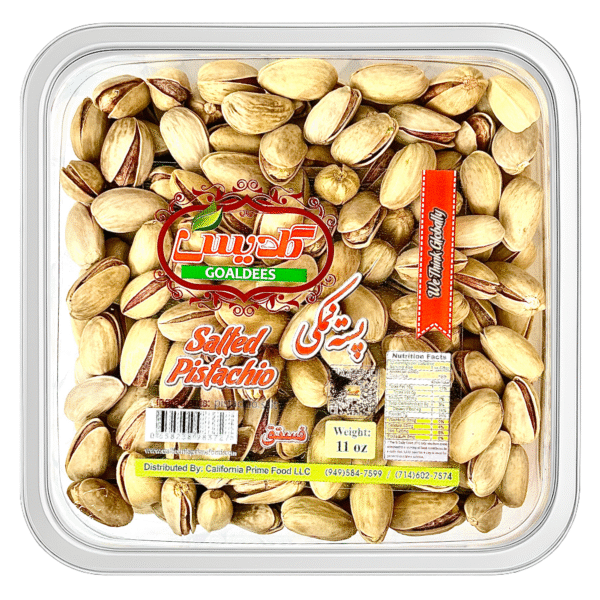
- For everyday snacking — a roasted, salted in-shell pistachio is the classic choice. Try Roasted & Salted Pistachio.
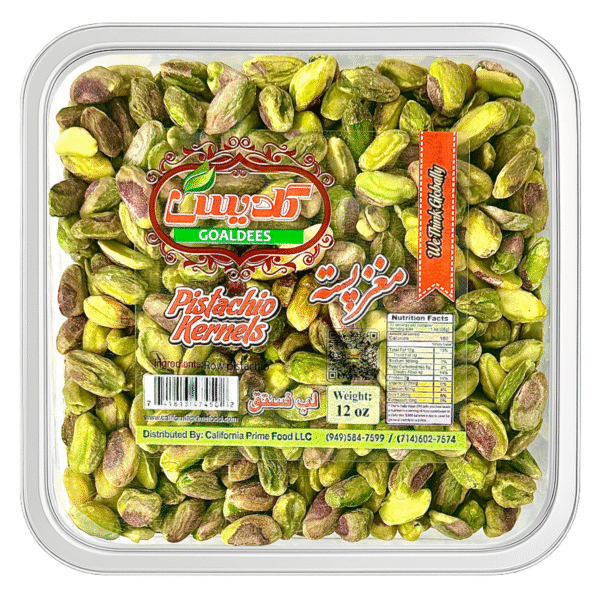
- For cooking and baking — shelled kernels save you the work. Try Pistachio Kernel.
- For garnishing rice and sweets — slivered khalal is the traditional form. Try Slivered (Khalal) Pistachio.
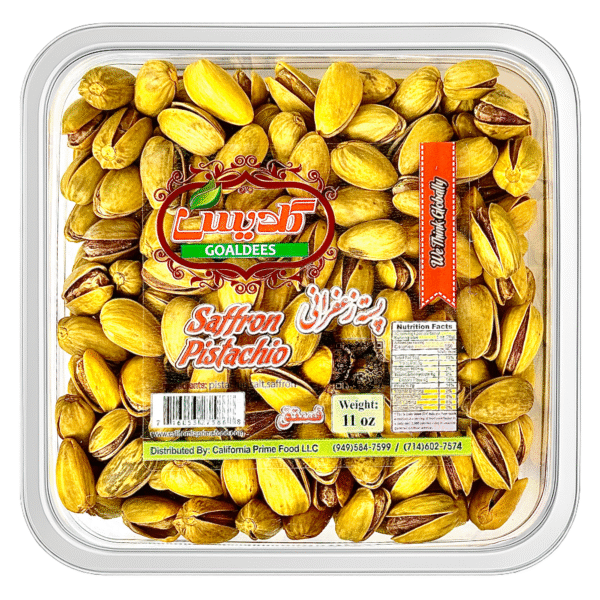
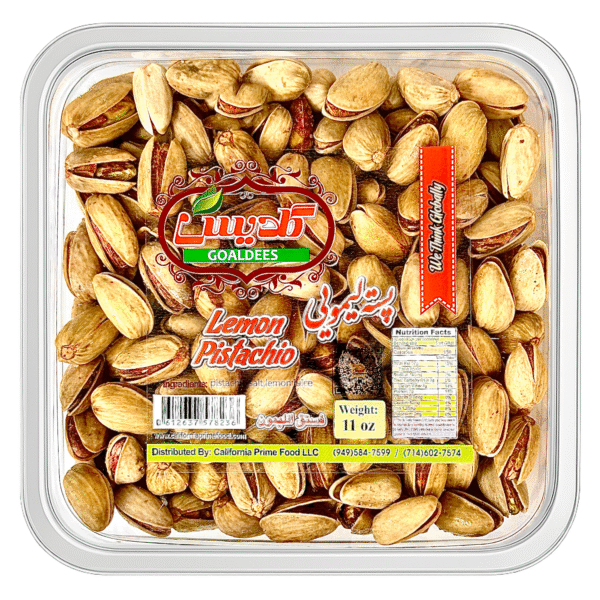
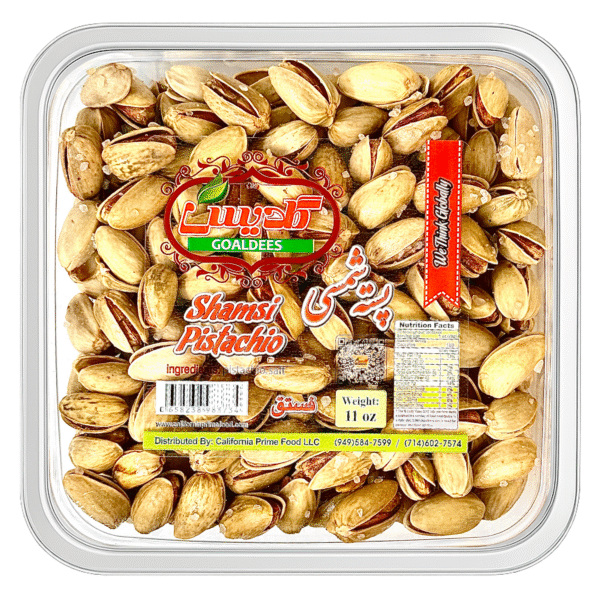
- For something different — Persian pistachios are also sold seasoned. Try Saffron Pistachio, Lemon Pistachio, or Shamsi Pistachio.
How to Store Pistachios
Pistachios are high in unsaturated fat, which is what makes them go rancid rather than simply stale. Keep them sealed in a cool, dark place; refrigerating or freezing extends freshness considerably, especially for shelled kernels and slivers, which have more surface area exposed to air than in-shell nuts.
Frequently Asked Questions
What is the difference between round and long Iranian pistachios?
The Iran Pistachio Association classifies cultivars by length-to-diameter ratio: round varieties (like Fandoghi and Kalleh Ghouchi) fall below 1.5, and long varieties (like Akbari and Ahmad Aghaei) are above 1.5. Long varieties are generally larger and command higher prices; Akbari has the largest kernel-to-in-shell weight ratio.
Which Iranian pistachio variety is the most common?
Fandoghi, which the Iran Pistachio Association reports accounts for around 50% of Iranian production. It’s small and round, with the highest count per kilogram, making it the standard snacking and confectionery pistachio.
What does “khalal” mean?
Khalal-e pesteh is the Persian term for pistachio kernels sliced lengthwise into thin slivers, used mainly as a garnish on rice dishes like shirin polo and tahchin, and on Persian sweets and ice cream.
How much protein is in pistachios?
USDA figures put raw pistachios at about 5.7 g of protein per 1-ounce serving (roughly 49 kernels), along with about 3 g of fiber and 159 calories.
Are Iranian pistachios the same as American pistachios?
They’re the same species but different cultivars grown in different conditions. Iran’s commercial varieties include Fandoghi, Kalleh Ghouchi, Akbari, and Ahmad Aghaei; the dominant American cultivar is Kerman, which the Iran Pistachio Association notes Ahmad Aghaei resembles.
Sources
- Iran Pistachio Association — Pistachio Varieties (cultivar classification, production share, agronomic notes)
- USDA FoodData Central — nutrient values for raw pistachio nuts
- American Pistachio Growers — complete protein analysis (Bailey, Carughi & Stein; industry-commissioned, American-grown pistachios)
- FAO production statistics as reported for 2022
Want the wider picture on Persian nuts? See our Persian Nuts Guide, or browse all Nuts.
Shop Persian pistachios
The pistachio varieties covered in this guide — add them straight to your cart.
-
Sale!
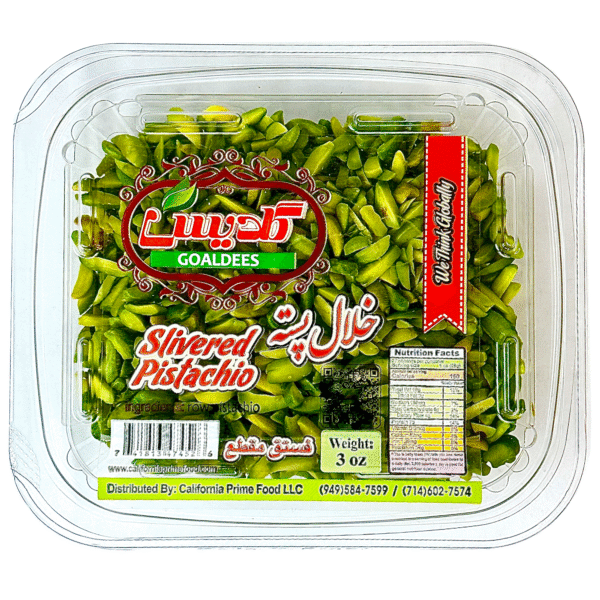
Slivered (Khalal) Pistachio 3 oz
Original price was: $12.50.$9.70Current price is: $9.70. -
-
-
-
-


Using pistachios in a bakery, ice cream shop or kitchen? Pistachio kernels and slivered pistachios are available at a wholesale price on orders of $1,000 or more, with free shipping in LA, Orange County and San Diego.