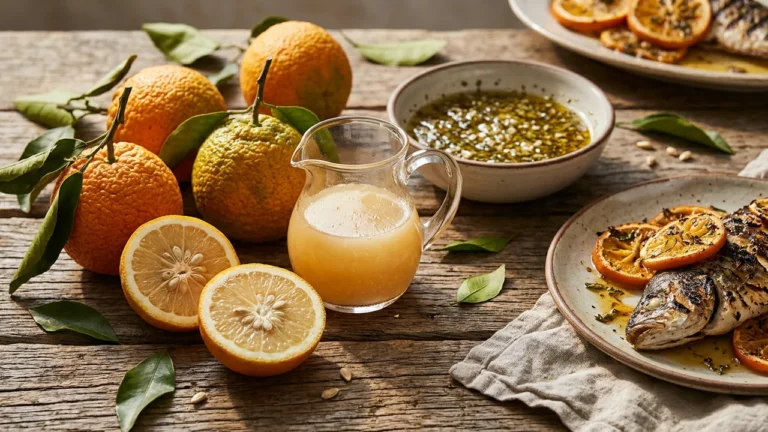

Pomegranate Molasses Substitutes That Actually Work, by Dish
The best pomegranate molasses substitute depends on the dish: tamarind paste for stews and marinades, balsamic glaze with a squeeze of lemon for dressings, and a sour fruit paste such as sour cherry or sour grape when you want the fruity tartness without the vinegar. Lemon juice with honey works in a pinch. Grenadine and plain pomegranate juice do not, because pomegranate molasses is sour first and sweet second, and both of those are the other way round. If you have a quart of pomegranate juice and an hour, you can also make the real thing, and below we show the arithmetic so you know exactly when to stop.
What Is Pomegranate Molasses?
Pomegranate molasses is pomegranate juice boiled down until most of its water is gone, leaving a thick, dark, glossy syrup that tastes sharply sour, then fruity, then faintly sweet. It is the same family of product under four names: rob-e anar (رب انار) in Persian, dibs rumman (دبس الرمان) in Arabic, nar ekşisi in Turkish, and pomegranate paste or pomegranate molasses in English. The word molasses is a little misleading. It refers to the texture, not the taste. Cane molasses is sweet; pomegranate molasses is mostly acid.
The numbers explain why. A 2021 study at Gümüşhane University in Turkey measured 17 commercial pomegranate sauces. Their dissolved solids ranged from 70 to 76.7 °Brix, their pH from 1.66 to 2.88, and their acidity from 2.65% to 7.58% (as citric acid). A pH under 3 is lemon-juice territory, and that sourness is concentrated alongside the sugar. A 2024 Iranian study of ten pastes sold in Iran found the same pattern: citric acid first, then malic and oxalic acid, with tartaric acid under 1% or absent. That acid profile matters when you choose a substitute, as you will see below.
In Persian cooking it is the backbone of fesenjan, the walnut and pomegranate stew, and of ash-e anar, pomegranate soup. In the Levant it carries muhammara and fattoush dressing. It belongs to the wider Persian family of sour fruit pastes covered in our Persian rob guide.
Pomegranate Molasses vs Paste vs Concentrate vs Grenadine
Five products sit side by side on the shelf, and only some of them are interchangeable.
| Product | What it is | Taste | Swap 1:1 for molasses? |
|---|---|---|---|
| Pomegranate molasses | Juice reduced to about 70–77 °Brix | Sour first, then sweet | — |
| Pomegranate paste / rob-e anar | The Persian name for the same reduction; often thicker | Sour first, often sharper | Yes. Start with a little less and taste |
| Pomegranate seeds paste (anardoon) | A spoonable paste with whole arils in it | Tart, fruity, textured | Yes in stews and dips; strain for dressings |
| Pomegranate juice concentrate | Industrial concentrate made to be diluted back into juice | Fruity, usually milder | Partly. Add lemon for sourness |
| Grenadine / pomegranate syrup | Sugar syrup flavoured with pomegranate | Sweet first | No. It adds sugar, not sourness |
Is pomegranate juice the same thing? No. It is the raw material. Pomegranate juice is about 15–16 °Brix. A study of industrially processed Spanish Mollar juices measured 15.15–15.71 °Brix with only 2.6–2.8 g/L of acid. To become molasses it has to lose roughly four-fifths of its weight as water, which is also why juice cannot simply be poured in where a recipe asks for molasses. You would need five or six times as much, and the dish would be soup.
The Best Pomegranate Molasses Substitutes, by Dish
Most substitute lists rank swaps from best to worst as if every recipe needed the same thing. It does not. Fesenjan needs a cup of something deep and sour that can simmer for an hour. A salad dressing needs a tablespoon of something bright that is never cooked. Pick by what the molasses is doing in the dish:
| Dish | What the molasses does | Best swap | Per 1 tbsp molasses |
|---|---|---|---|
| Fesenjan, khoresh, braises | Long-cooked sour body | Tamarind paste, or sour cherry paste | 1 tbsp, then taste after 20 minutes of simmering |
| Ash-e anar and soups | Sourness that survives dilution | Sour grape paste, or verjuice reduced by half | 2 tsp paste, or 2 tbsp reduced verjuice |
| Muhammara and dips | Sour-sweet depth with a resinous edge | Homemade reduction (below); lemon and honey as a last resort | 2 tsp lemon juice + 1 tsp honey |
| Salad dressings, fattoush | Bright acidity and gloss | Balsamic glaze with a squeeze of lemon | 1 tbsp glaze + ½ tsp lemon juice |
| Marinades and meat glazes | Acid to tenderise, sugar to caramelise | Tamarind paste with a little honey | 1 tbsp tamarind + ½ tsp honey |
| Drinks and sharbat | Tart fruit syrup | Sour cherry paste diluted, or pomegranate juice with lemon | See our sharbat ratios |
Every quantity there is a starting point. Pomegranate molasses itself varies enormously between brands. The Gümüşhane samples ranged nearly threefold in acidity, so no substitution ratio can be exact. Add most of it, cook, taste, and correct.
1. Tamarind paste: the closest match for stews
Tamarind is the swap most cooks reach for, and it earns its place: thick, dark, fruity and sour, it behaves in a pot almost exactly like pomegranate molasses. The flavour is different, though, and the chemistry says why. Tamarind pulp is one of the richest natural sources of tartaric acid, reported at 8–18% of the pulp. Pomegranate’s sourness is citric acid, with almost no tartaric acid at all. Tartaric acid reads as rounder and more prune-like, citric as sharper and brighter. So tamarind gives you the right weight and the right sourness, with a slightly darker, date-like flavour. In fesenjan that is a pleasant variation; in a light dressing it can taste muddy.
Tamarind products differ in strength. A spoonable paste like Goaldees tamarind paste can go in tablespoon for tablespoon. Very thick, block-style concentrates are stronger, so start with half.
2. Sour fruit pastes: sour cherry, sour grape, green plum
Iranian kitchens have a whole shelf of sour fruit pastes, and they are the most faithful substitutes because they are made the same way as pomegranate molasses, by boiling sour fruit down. Sour cherry paste is the closest in colour and fruitiness, so use it where the molasses is meant to be tasted. Sour grape paste is sharper and less fruity, a souring agent more than a flavour, and it suits soups, rice and ash. Green plum and cornelian cherry pastes sit between the two. Use them one for one and taste.
3. Balsamic glaze with lemon: best for dressings
Balsamic glaze is the internet’s favourite answer, and for a cold dressing it is a good one: it has the gloss, the body and the sweet-tart balance. Its weakness is that its sourness comes from acetic acid, the acid of vinegar, so it brings a vinegary aroma that pomegranate molasses does not have, and it is noticeably sweeter. A small squeeze of lemon pulls it back toward citric sharpness. In a long-cooked stew balsamic tends to taste of balsamic, so keep it for dishes that are not cooked.
4. Verjuice or lemon juice with a little honey: the pantry fallback
Verjuice, the sour juice of unripe grapes, is the gentler, more fruity option. Reduce it by half first so it does not water the dish down. Plain lemon juice with honey or sugar is the substitute everyone has. Fresh lemon juice carries roughly 48 g of citric acid per litre, so it supplies the right kind of acid. It gives none of the depth or colour, though, which is why our muhammara guide warns that nothing quite replaces the real molasses in that dip.
What not to use
- Grenadine. It is a sweet syrup. Swapping it in adds sugar where the recipe wanted sour.
- Cane or blackstrap molasses. It shares a name and a texture, not a flavour. It is bitter-sweet with no fruit acid.
- Cranberry sauce or jam. These are too sweet and set with pectin. If you are desperate, thin a sour jam with lemon and taste hard.
- Straight pomegranate juice. It is the right flavour at about a fifth of the strength. Reduce it first (see below).
How to Make Pomegranate Molasses at Home (With the Arithmetic)
Most homemade recipes boil pomegranate juice with half a cup of sugar. There are two reasons. Sugar gets you a thick syrup sooner, and supermarket juice is usually made from sweet dessert pomegranates, which are not very sour. The Spanish Mollar juices above carried only about 0.27% acid. Research on Tunisian varieties found sour pomegranates get their sourness from citric acid, while sweet ones are dominated by milder malic acid. Concentrate a sweet juice and you get something sweet.
We would rather add acid than sugar, so this version uses lemon. Here is how the numbers work:
- 4 cups (about 1,000 g) of pomegranate juice at ~15.5 °Brix holds about 155 g of dissolved sugars and acids.
- Commercial molasses starts at about 70 °Brix. To reach that, those 155 g plus the lemon’s solids have to end up as about 230 g of syrup, about ¾ cup. That is a reduction of roughly six to one by volume.
- Juice from a sweet variety reduced that far would land at only about 1.2% acid, well under the 2.65–7.58% of the commercial sauces. Adding ⅓ cup of fresh lemon juice (about 3.9 g of citric acid) brings the finished syrup to roughly 2.8%, inside the commercial range, with no added sugar.
Method
- Weigh your empty saucepan (a wide one reduces faster) and note the weight.
- Add 4 cups of 100% pomegranate juice and ⅓ cup of freshly squeezed lemon juice. No sugar.
- Bring to a boil, then lower the heat to a steady bare simmer. Stir every 10 minutes and scrape the sides.
- After about 45 minutes, start weighing. When the pan holds about 230 g more than its empty weight, it is done. Expect roughly an hour to an hour and a half in total.
- No scale? It is ready when it coats a spoon like warm maple syrup and a line drawn through it on a cold plate holds. It thickens a lot as it cools, so stop early rather than late.
- Cool, pour into a clean jar and refrigerate.
If you like a softer, sweeter molasses for drizzling, stir in a tablespoon or two of sugar at the end and taste. Adding it at the end, rather than the start, lets you decide how much it actually needs.
How to Tell a Good Pomegranate Molasses When You Buy One
Not every bottle labelled pomegranate is mostly pomegranate. Turkey, where nar ekşisi is a kitchen staple, decided the problem was serious enough to legislate. A March 2023 amendment to the Turkish Food Codex rules that nothing but pomegranate, pomegranate juice and/or pomegranate juice concentrate, and water may go into nar ekşisi. It also bans look-alike products sold under names such as nar sosu (pomegranate sauce), nar ekşili sos and nar aromalı şurup (pomegranate-flavoured syrup). Those had to leave the shelves by 30 June 2024.
The quality gap the rule was aimed at is visible in the lab. Across the 17 commercial sauces in the Gümüşhane study, total phenolic content, the compounds that carry much of pomegranate’s colour and astringency, ranged from 124 to 9,567 mg per kilogram. That is about a 77-fold spread between products sold under the same name. In Iran, the 2024 study found no added sugar in any of its ten pastes, but 4 of the 5 traditional, unbranded samples contained starch, a cheap thickener.
Practical checks, none of which need a laboratory:
- Read the first ingredient. It should be pomegranate juice or concentrate. If sugar, glucose syrup or date syrup comes first, you are buying a sweetened sauce.
- Look at the name. “Pomegranate sauce” or “pomegranate-flavoured syrup” is the category Turkey banned for good reason.
- Taste it neat. Real pomegranate molasses makes you wince slightly before the sweetness arrives.
- Tilt the jar. A starch-thickened paste looks dull and gluey rather than glossy, and it clings to the glass in sheets.
What is in ours, plainly stated. The label on the Goaldees pomegranate paste (rob-e anar) lists thick pomegranate juice, salt and citric acid. There is no sugar, no date syrup and no starch, which is why it is sour-forward and why we tell muhammara and fesenjan cooks to start low. It is not pomegranate-only, though. Under Turkey’s 2023 rule, a jar with salt and citric acid could not be sold there as nar ekşisi. Because we sell it, we would rather you read that here than discover it on the label. The pomegranate seeds paste (anardoon) is a separate product, a spoonable paste with whole arils suspended in it.
Storage and Shelf Life
Between its high sugar concentration and its low pH, pomegranate molasses is hard for microbes to live in, which is why it keeps well. Refrigerate it after opening anyway. Heat and time slowly darken it and build up hydroxymethylfurfural (HMF), a compound that forms when sugars are heated. Both the Turkish and Iranian studies found HMF varied with how the product was made and stored, and one traditional Iranian paste exceeded the national limit. A jar that has turned from ruby-brown to near black and tastes flat has simply aged. Use it up and buy fresh.
How much sugar is in a spoonful? A tablespoon weighs roughly 20 g, and at 70–77 °Brix about 14–15 g of that is dissolved solids. Most of that is the fruit’s own sugar, the rest its acids. It is a concentrate, used by the spoonful, not a health food in itself.
Frequently Asked Questions
What is the best substitute for pomegranate molasses?
For stews and marinades, tamarind paste, used one for one. For salad dressings, balsamic glaze with a squeeze of lemon. For soups and rice, a sour fruit paste such as sour grape or sour cherry. If you have pomegranate juice and an hour, reduce four cups with a third of a cup of lemon juice to about three-quarters of a cup and you have the real thing.
Can I use balsamic vinegar instead of pomegranate molasses?
Yes, best as a reduced balsamic glaze and best in dishes that are not cooked, such as dressings and drizzles. Balsamic is sweeter and smells of vinegar, so add a little lemon juice to sharpen it, and avoid it in long-simmered stews like fesenjan, where its flavour takes over.
Is pomegranate juice the same as pomegranate molasses?
No. Pomegranate juice is about 15–16 °Brix; pomegranate molasses is the same juice boiled down to about 70–77 °Brix. That is roughly a six-to-one reduction by volume, so the molasses is far thicker, sourer and more intense. Juice can only stand in for molasses after you reduce it.
Is grenadine the same as pomegranate molasses?
No. Grenadine is a sweet syrup flavoured with pomegranate, used in drinks. Pomegranate molasses is a sour reduction of pomegranate juice used in cooking. Using grenadine in its place adds sugar where the recipe wanted acidity.
Is pomegranate paste the same as pomegranate molasses?
Essentially yes. Pomegranate paste, rob-e anar, dibs rumman and nar ekşisi all name the same reduced pomegranate juice. Pastes labelled the Persian way are often thicker and sharper, so start with a little less than the recipe asks for and taste.
What can I use instead of pomegranate molasses in muhammara?
Nothing gives quite the same result. The closest is a quick homemade reduction of pomegranate juice and lemon. If you have nothing else, use 2 teaspoons of lemon juice and 1 teaspoon of honey per tablespoon of molasses, and expect a brighter, less deep dip.
Does pomegranate molasses need to be refrigerated?
Refrigerate it after opening. Its acidity and sugar make it resistant to spoilage, but cool storage slows the darkening and flavour loss that come with time and warmth.
Sources
- Türk Gıda Kodeksi Yönetmeliğinde Değişiklik Yapılmasına Dair Yönetmelik — Republic of Türkiye, Ministry of Agriculture and Forestry, Resmî Gazete No. 32142, 24 March 2023. The permitted ingredients of nar ekşisi, the banned look-alike product names, and the 30 June 2024 deadline.
- Determination of physical, chemical and antioxidant properties of pomegranate sauces sold in the market — Kamış YE (advisor Akar B), Master’s thesis, Gümüşhane University, 2021. Brix, pH, acidity, HMF and total phenolics of 17 commercial pomegranate sauces.
- Investigation of Quality and Purity of Some Industrial and Traditional Pomegranate Pastes by Measuring the Physicochemical Characteristics and Instrumental Method — Mahmoodi S, Jafari M, Ghasemi-Varnamkhasti M, Ahmadi H, Journal of Health System Research, 2024;19(4). Sucrose, starch, HMF and organic-acid profile of ten pastes on the Iranian market.
- Chemical guide parameters for Punica granatum cv. ‘Mollar’ fruit juices processed at industrial scale — Vegara S, Martí N, Lorente J, et al., Food Chemistry, 2014;147:203. Brix, acidity and organic acids of industrially processed pomegranate juice.
- Seed and juice characterization of pomegranate fruits grown in Tunisia: comparison between sour and sweet cultivars — Hasnaoui N, Mars M, Ghaffari S, Trifi M, Melgarejo P, Hernandez F, Industrial Crops and Products, 2011;33. Citric acid as the driver of sourness in sour pomegranates; malic acid in sweet ones.
- Morpho-biochemical Characterization of Tamarind (Tamarindus indica L.) — Reddy KGA, Prasad TV, Shankar SK, et al., Legume Research, 2024. Tamarind pulp as the richest natural source of tartaric acid (8–18%).
- Quantitative assessment of citric acid in lemon juice, lime juice, and commercially-available fruit juice products — Penniston KL, Nakada SY, Holmes RP, Assimos DG, Journal of Endourology, 2008;22(3):567–570. Citric acid content of fresh lemon juice.
This article is general cooking and food-science information. It makes no health claims about pomegranate molasses or any product mentioned. Ratios are starting points; products vary, so taste as you cook.
Cooking for a restaurant, café or catering kitchen? Pomegranate paste, tamarind paste and our other sour fruit pastes are available at a wholesale price on orders of $1,000 or more, with free shipping in LA, Orange County and San Diego.
Shop Pomegranate Molasses and the Substitutes
The products this guide mentions, from Goaldees (also searched as Goldis), shipped nationwide across the US.